Evidence before conclusions
This project separates three categories: established scientific observations, reasonable inferences and speculative possibilities. It does not present imagined Pelagian anatomy, technology or history as palaeontological findings.
Working hypotheses
Null hypothesis (H₀): Available geological and palaeontological evidence does not establish a prehistoric technological marine civilisation; observations are explained without invoking one.
Alternative hypothesis (H₁): An independently evolved marine civilisation may once have existed and may have produced identifiable traces, even if those traces differ from human industrial signatures.
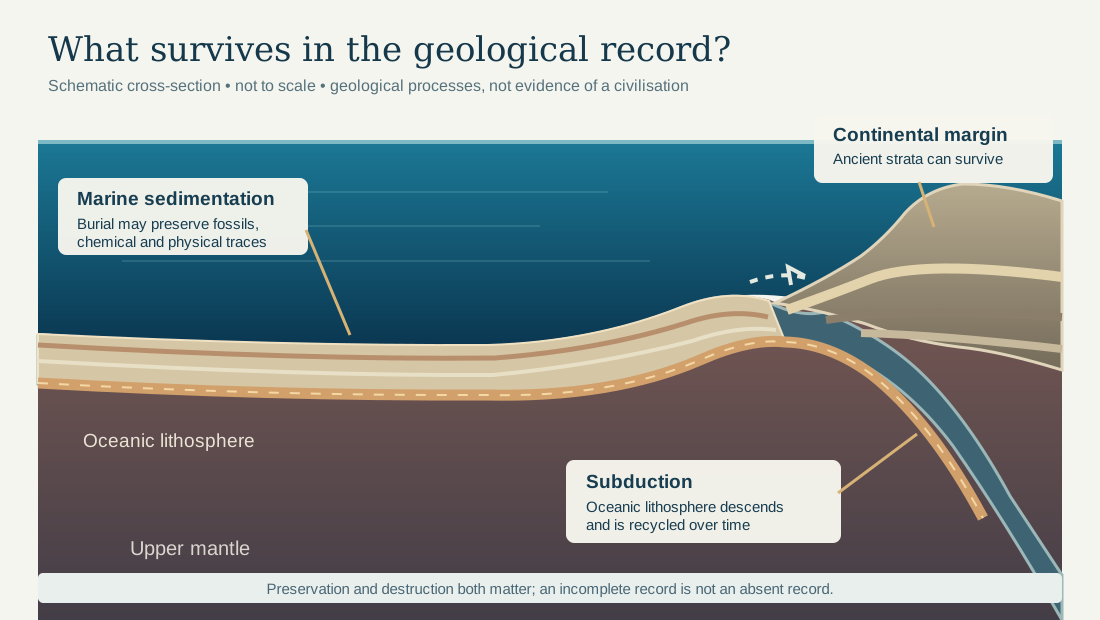
What could be tested?
- Whether proposed biological capabilities and learned environmental manipulation are physically and ecologically plausible in marine environments.
- Whether particular chemical, sedimentary or fossil patterns could distinguish engineered processes from natural ones.
- Whether candidate traces survive scrutiny against ordinary geological explanations.
- Whether new evidence can be independently examined and reproduced.
What could disprove a claim?
Specific versions of the hypothesis should be rejected when their proposed mechanisms violate well-established physical constraints or when purported evidence is better explained by natural processes. The absence of surviving evidence alone cannot prove a civilisation existed.