What if humanity wasn't Earth's first civilisation?
Could intelligence have taken a radically different path beneath the ancient oceans—and would we recognise the traces it left behind?
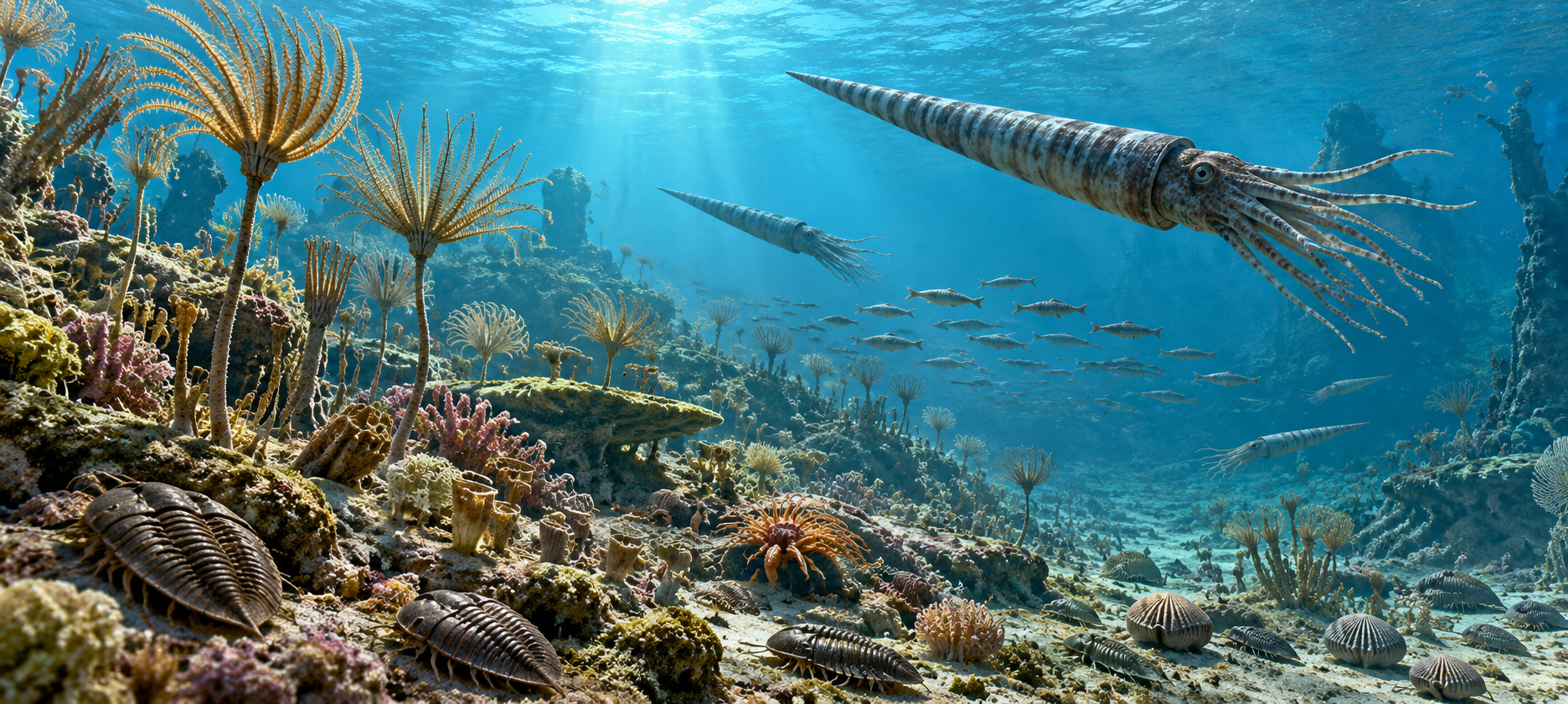
Beyond the familiar story of life.
The Pelagian Hypothesis proposes that complex intelligence and potentially technological civilisation could have evolved within Earth's ancient marine ecosystems, independently of humanity.
It explores whether such a civilisation could have emerged, developed and disappeared without leaving evidence readily recognisable in the geological record.
This is an exploratory scientific hypothesis—not a claim that an ancient marine civilisation has been discovered.
Read the hypothesis ↗Three questions.
One ancient planet.
Rather than starting with an answer, the project examines what biology, geology and the history of life might allow us to ask.
Marine Intelligence
How could communication, learning, manipulation and complex social behaviour evolve in the oceans?
Explore evolutionary pathways ↗GEOLOGICAL HISTORYGeological Evidence
What traces could survive immense timescales, and how might we distinguish them from natural processes?
Examine the evidence ↗SCIENTIFIC ENQUIRYScientific Method
What would make this idea testable—and what observations might challenge or rule out its claims?
Review the method ↗What could deep time make possible?
Our species is young in geological terms. A much longer hypothetical evolutionary window invites questions about biology, innovation and preservation—not conclusions about a lost civilisation.
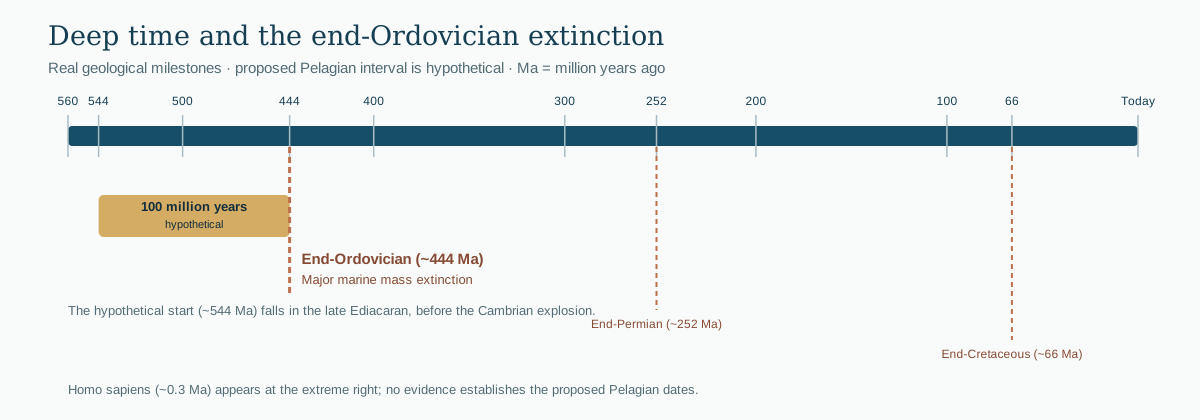
Human ancestry extends much further back than Homo sapiens, and civilisation is much more recent. Geological timescales do not imply inevitable technological development.
Explore evolutionary pathways ↗Curiosity is the beginning.
Evidence is the standard.
Extraordinary possibilities deserve rigorous questions. The project draws clear lines between what is known, what can be inferred and what remains imagined.
Established science
Begin with palaeontology, marine ecology, evolutionary biology and the physical history of Earth.
Alternative pathways
Explore plausible constraints on intelligence, culture and environmental modification beneath water.
Competing explanations
Identify possible signatures, examine natural alternatives and state where evidence is absent.
Could the geological record forget a civilisation?
In 2018, Gavin Schmidt and Adam Frank asked whether a civilisation from deep geological time would leave evidence that scientists could still detect today.
Their Silurian Hypothesis is a thought experiment, not evidence that an earlier civilisation existed. It offers a rigorous starting point for thinking about preservation, detection and uncertainty.
Explore the research ↗“What evidence would we expect to find—and what might we never recognise?”
Inspired by the scientific questions explored in the Silurian Hypothesis. This wording is our own, not a quotation from the paper.The Research Journal
Reading, research notes and critical examination of a developing hypothesis. Entries will be published as the work progresses.
Hello world!
↗Andrew Hughes
Founder · The Pelagian Hypothesis
An independent enquiry into an ancient possibility.
Andrew Hughes holds a degree in Environmental Science and has published work in network mapping and trend analysis.
Drawing on environmental science, systems thinking and network analysis, he explores alternative evolutionary pathways, ecological complexity and the challenges of recognising traces of ancient intelligence.
About the founder ↗