The Pelagian Hypothesis — Research Journal 001
By Andrew Hughes | 21 October 2026
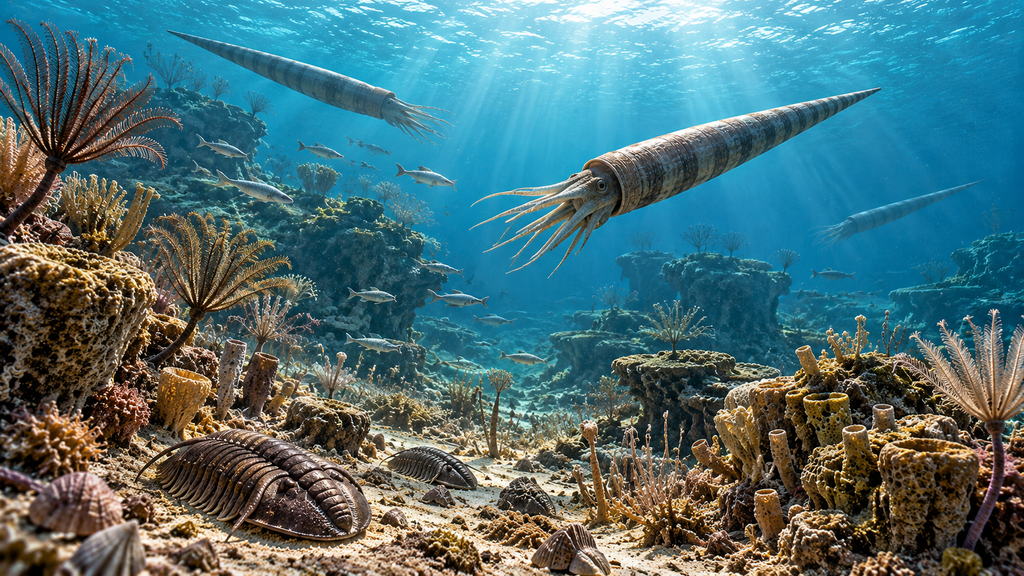
What if the history of intelligence on Earth began long before humanity — not on land, but beneath the oceans?
Approximately 444 million years ago, Earth experienced one of the greatest mass extinctions in its history. The end-Ordovician extinction devastated marine ecosystems that had developed over millions of years.
At that time, complex life was overwhelmingly concentrated in the oceans. Marine environments supported increasingly diverse predators, shelled animals, reef-building organisms and intricate ecological relationships.
But could those ancient oceans have supported something more?
The Pelagian Hypothesis explores whether an intelligent marine lineage might have evolved, developed increasingly sophisticated ways of manipulating its environment and eventually established a civilisation fundamentally different from our own.
This is not a claim that such a civilisation existed. No verified Pelagian fossils, artefacts or technological structures have been discovered.
It is an investigation into whether the evolutionary and environmental conditions of early Earth could have permitted such a development — and what evidence we should expect if it occurred.
The evolutionary window
The current Pelagian model considers a hypothetical evolutionary interval extending from approximately 544 million years ago to the end-Ordovician extinction, around 444 million years ago.
That represents roughly 100 million years.
However, the beginning of this interval falls within the late Ediacaran, before the Cambrian diversification of animal life. It would be scientifically unjustified to assume that recognisably intelligent, cephalopod-like animals already existed at that point.
Instead, the earlier date represents a possible starting boundary for investigating the ancestry of a hypothetical marine lineage.
The Cambrian period subsequently witnessed major developments in animal anatomy, ecological relationships, locomotion and predation.
Recent fossil research has also pushed the documented origins of cephalopods further into the Cambrian. A 2026 study described Eoceras shaanxiense, a tiny early Cambrian organism interpreted as an early cephalopod possessing a primitive structure associated with buoyancy regulation.
This discovery is relevant because it extends the period during which cephalopod evolution could have occurred. It does not demonstrate that early cephalopods possessed advanced intelligence.
By the Ordovician, cephalopods had diversified, while reef ecosystems became increasingly complex.
The central question is whether an independently evolving marine lineage could have developed sophisticated cognition and manipulative abilities within this broad interval.
The available fossil record does not establish that it did.
Intelligence need not follow the human pathway
Humans are the only known species to have developed a technological civilisation.
Consequently, discussions of civilisation often begin with human evolutionary history: upright locomotion, hands, tools, fire, agriculture and industrial technology.
But these developments are not necessarily universal requirements for intelligence.
Modern cephalopods demonstrate that complex nervous systems, learning and behavioural flexibility can evolve outside the vertebrate lineage.
Their existence illustrates an important evolutionary principle: sophisticated cognition does not require a human body plan.
The Pelagian Hypothesis therefore considers a marine lineage whose evolutionary development may have been shaped by different pressures.
In this proposed model, early environmental manipulation becomes a particularly important transition.
An organism capable of deliberately rearranging objects, modifying shelters, exploiting biological resources or altering its immediate environment could gain survival advantages.
Across many generations, ecological selection might favour improvements in sensory processing, coordination, manipulative anatomy and learning.
If those abilities were combined with social transmission of knowledge, increasingly complex behaviour might become possible.
This is a proposed evolutionary mechanism, not a demonstrated history. It requires investigation into the emergence of cumulative culture, the costs of neural development and the ecological conditions necessary to sustain such abilities.
The Pelagian equivalent of fire
Human technological development was transformed by the control of fire.
Fire enabled cooking, heating, material processing and eventually metallurgy.
An entirely aquatic civilisation would face very different physical constraints.
Conventional combustion and smelting are difficult to achieve underwater. Rather than assuming that an intelligent marine species would somehow reproduce human industry, the Pelagian Hypothesis investigates a different pathway.
Its proposed starting point is environmental manipulation.
As this capability became more sophisticated, hypothetical Pelagian communities might have learned to exploit two energy systems already present in marine environments.
Geothermal energy would offer access to heat and chemical gradients associated with geological activity, including hydrothermal environments.
Biological energy could involve the use of organisms, metabolic processes and symbiotic relationships to capture, transform or store energy.
These are real categories of natural energy availability. What remains unproven is whether an ancient marine species could have developed mechanisms to capture, regulate, store and distribute energy on a technologically useful scale.
That distinction is crucial.
An energy source is not automatically an energy technology.
Nevertheless, the possibility of an alternative technological pathway deserves examination on its own physical and biological terms.
From environmental manipulation to farming
The Pelagian model proposes that increasingly sophisticated manipulation of the marine environment preceded organised food production.
This order matters.
Reef cultivation is not proposed as the original cause of Pelagian intelligence. Rather, it would represent a later achievement made possible by accumulated knowledge, cooperation and control over surrounding ecosystems.
Early food acquisition might have involved hunting, gathering and the selective use of marine resources.
More organised societies could, hypothetically, have progressed towards managing food-producing organisms and eventually cultivating complex reef environments.
The Ordovician fossil record confirms that reef-building ecosystems existed. Research documents reef structures constructed by bryozoans, stromatoporoids and other marine organisms.
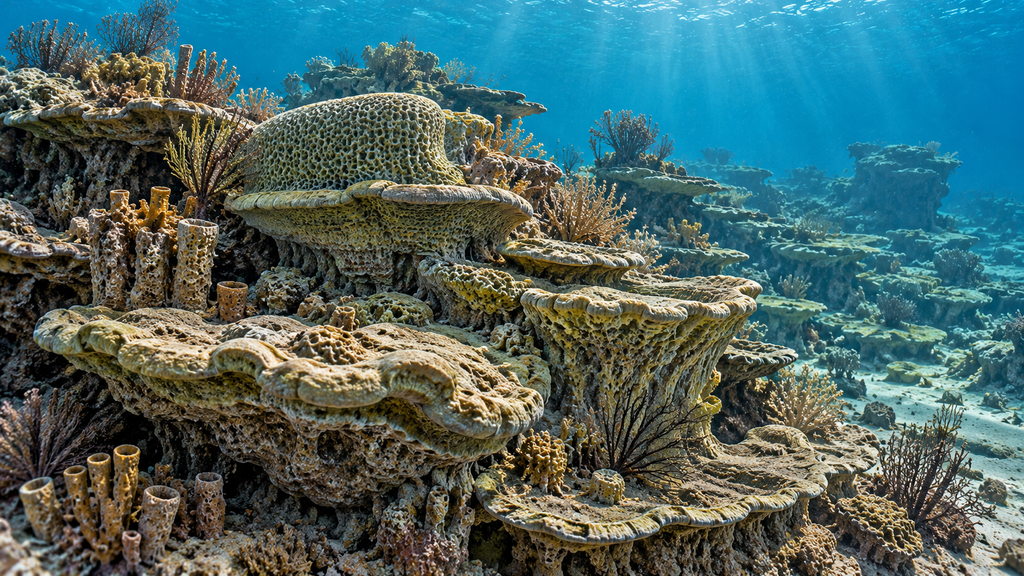
Those reefs were natural biological systems.
The Pelagian Hypothesis asks whether deliberate cultivation of comparable ecosystems would produce distinctive features that could survive fossilisation.
Could repeated spatial arrangements, unusual species associations or patterns of ecological management ever be distinguished from natural reef development?
At present, there is no verified evidence of such cultivation.
The challenge is to identify a diagnostic signature that cannot be adequately explained by known biological or geological processes.
Where are the fossils?
This is one of the strongest objections to the hypothesis.
A hypothetical civilisation might leave relatively few recognisable manufactured artefacts, particularly if its material culture relied heavily on biological systems.
Living structures decay, are consumed, become buried or are altered by geological processes.
But this does not mean that every trace would disappear.
The Cambrian and Ordovician fossil records preserve remarkable evidence of ancient marine organisms, including occasional soft-bodied anatomy.
An intelligent lineage evolving over tens of millions of years should potentially leave evidence of its ancestry, ecological relationships or anatomical development.
Therefore, geological recycling alone cannot explain the absence of recognised Pelagian fossils.
Several possibilities can be examined: incomplete preservation, limited geographic distribution, misidentification of unusual organisms or evolutionary traits that do not fossilise readily.
Each would require independent supporting evidence.
The hypothesis must also confront the possibility that no such lineage existed.
That is an essential part of treating the question scientifically.
The end-Ordovician extinction
Around 444 million years ago, major environmental changes disrupted marine ecosystems.
The extinction is associated with climatic cooling, glaciation, changes in sea level and disturbances to ocean conditions.
For the Pelagian Hypothesis, this event provides a meaningful geological boundary.
Could an advanced marine lineage have been vulnerable to the same environmental upheavals that affected other organisms?
Might its food systems, habitats or ecological relationships have been particularly sensitive to rapid environmental change?
These questions are legitimate to investigate, although there is currently no evidence that an intelligent civilisation was present.
The extinction supplies a historical event against which the hypothesis can be examined. It does not, by itself, establish the existence or disappearance of the Pelagians.
What would constitute evidence?
The most productive next step is not to assume that a civilisation existed, but to identify what observations might support or contradict the proposal.
Potential research directions include:
- Examining Cambrian and Ordovician fossils for anatomical evidence relevant to sophisticated manipulation and cognition.
- Investigating the ecological and energetic constraints on complex marine nervous systems.
- Studying ancient reef structures for patterns that could distinguish deliberate cultivation from natural growth.
- Exploring whether sustained biological engineering could produce identifiable sedimentary or geochemical signatures.
- Testing whether any proposed signatures can be explained more simply by established natural processes.
These investigations must be informed by existing palaeontology and geology, not by treating unexplained features as automatic evidence of intelligence.
In 2018, Gavin Schmidt and Adam Frank published the Silurian Hypothesis, asking whether an ancient industrial civilisation could be detected in the geological record.
Their work provides a useful methodological starting point, although its primary analysis concerns industrial activity rather than the biological marine civilisation proposed here.
The Pelagian Hypothesis extends the question into a different environment and a substantially earlier period of Earth’s history.
A different history of intelligence?
Human civilisation demonstrates one successful pathway from biological evolution to sophisticated technology.
It does not establish that every possible civilisation must follow the same sequence.
The Pelagian Hypothesis investigates whether a marine lineage could have developed its own pathway through environmental manipulation, accumulated knowledge, organised food production and increasingly complex ecological relationships.
For now, that pathway remains speculative.
Its proposed timescale is uncertain. Its biological feasibility is unresolved. Its technological mechanisms require substantial further investigation. And the fossil record presents serious challenges.
These are not questions to avoid.
They are the questions that define the research.
If intelligence could have evolved along a radically different pathway in Earth’s ancient oceans, what would we need to discover to recognise it?
That is where the investigation begins.
References and further reading
- Schmidt, G. A. & Frank, A. (2018, published in journal volume 2019). The Silurian hypothesis: Would it be possible to detect an industrial civilization in the geological record? International Journal of Astrobiology. https://doi.org/10.1017/S1473550418000095
- Song, Z. et al. (2026). Earliest siphuncle-bearing cephalopod from the early Cambrian. Nature. https://doi.org/10.1038/s41586-026-10868-y
- Hong, J. et al. (2018). The earliest evolutionary link of metazoan bioconstruction: Laminar stromatoporoid–bryozoan reefs from the Middle Ordovician of Korea. Palaeogeography, Palaeoclimatology, Palaeoecology. https://doi.org/10.1016/j.palaeo.2017.12.018
- International Commission on Stratigraphy. International Chronostratigraphic Chart. https://stratigraphy.org/chart
- Smithsonian Ocean. Cephalopods: Octopus, Squid, Cuttlefish, and Nautilus. https://ocean.si.edu/ocean-life/invertebrates/octopuses-squids-and-relatives
Research note: The Pelagian Hypothesis is an exploratory model. No direct evidence of a prehistoric intelligent marine civilisation has been established.