From ecological complexity to cognition
The oceans supported intricate ecological interactions long before terrestrial ecosystems became established. The evolution of nervous systems, sensory capabilities, mobility and social behaviour occurred along multiple lineages and at different times.
A hypothetical sequence
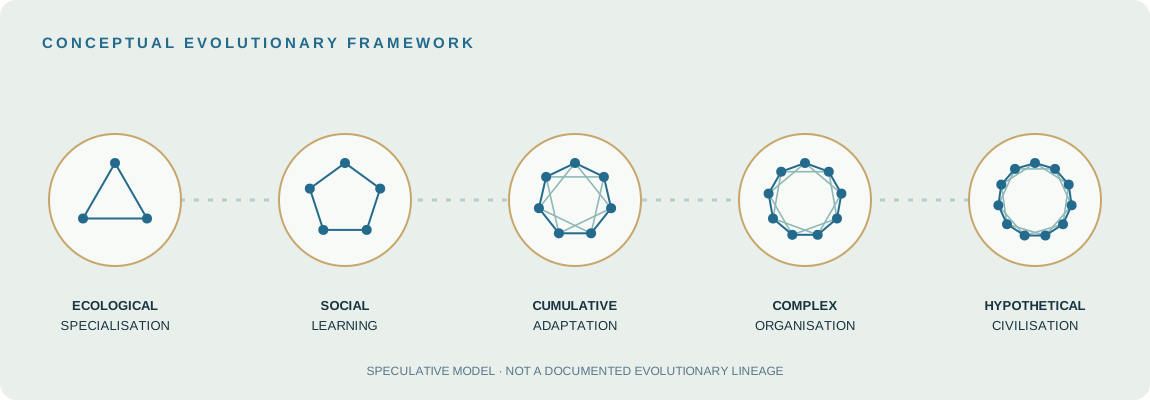
A possible physical progression

The sequence below describes a proposed evolutionary and cultural pathway, not a documented fossil lineage. Its central idea is that environmental manipulation could develop long before organised farming, with feedback between learned behaviour, anatomy and ecological selection across many generations.
- Early marine ancestors: food gathering, predation, sensing and flexible responses to changing environments.
- Environmental manipulation: increasingly deliberate use and rearrangement of objects and surroundings, potentially creating new survival advantages.
- Dexterity, cognition and culture: selection and learning might favour finer appendage control, sophisticated perception, communication and transmission of skills across generations.
- Organised food production: management of food resources and eventually deliberate farming, with reef cultivation emerging later as a more developed cultural practice.
- Hypothetical advanced civilisation: long-lived institutions, shared knowledge and complex ecological management—none of which has been demonstrated in the ancient record.
From manipulation to cultivation
The human comparison is about the transformative importance of learning to change one's surroundings—not a claim that marine organisms discovered fire. The Pelagian scenario explores a different route: manipulation first, increasingly complex culture and skills next, and deliberate food production and reef cultivation much later. Environmental manipulation does not itself change an individual's genes; evolutionary change would require heritable variation and selection over generations.
Marine constraints
Manipulation without hands, access to sufficient energy and oxygen, the durability of materials underwater and the transfer of complex knowledge all require serious analysis. The precise anatomical starting point and the pace of any such changes remain unknown. A speculative evolutionary diagram must never be mistaken for a fossil reconstruction.