Starting from known science
The relevant fields include evolutionary biology, palaeontology, marine ecology, geochemistry, sedimentology and the study of animal cognition. The aim is to assemble reliable scientific context before making any further inference.
The Silurian Hypothesis
In 2018, Gavin A. Schmidt and Adam Frank published a thought experiment asking whether an earlier industrial civilisation could be detected in the geological record. Their work does not claim that such a civilisation existed. It provides a useful framework for asking how long-lived geological signatures might be recognised.
Read the Schmidt and Frank paper: “The Silurian Hypothesis” (2018) ↗
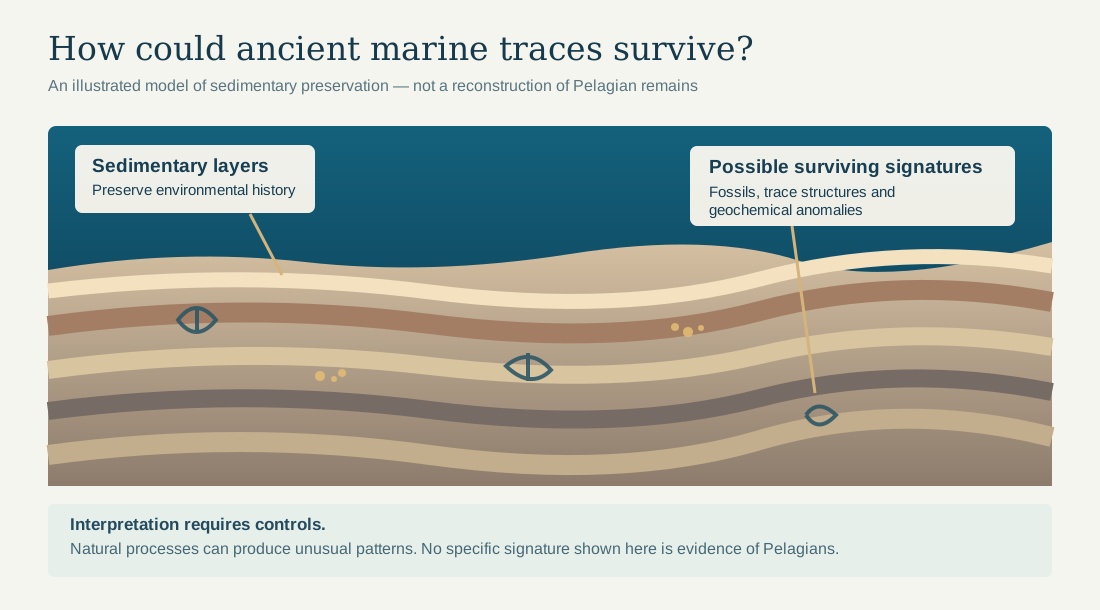
The incomplete geological record
Oceanic crust is continually formed and recycled through plate tectonics. Sedimentation, metamorphism and erosion can also alter or erase ancient traces. Yet many fossils, geochemical anomalies and sedimentary structures do survive. Claims about lost evidence must account for both destruction and preservation.
Marine intelligence
Cephalopods and cetaceans demonstrate that complex cognition can evolve in water, but their histories do not establish a continuous lineage leading to technological civilisation. Intelligence, manipulation, cultural transmission and sustained environmental modification are separate questions.
Mass extinctions and competing histories
The end-Ordovician extinction around 444 million years ago profoundly affected marine ecosystems and is the primary extinction boundary examined by this project. A 100-million-year hypothetical lineage ending near this event would begin around 544 million years ago, in the late Ediacaran, before the Cambrian diversification of animal life. That is a highly speculative biological scenario, not a supported chronology. The end-Permian (~252 Ma) and end-Cretaceous (~66 Ma) events provide later comparative context, not the proposed Pelagian disappearance date.
Counterarguments that matter
- No confirmed Pelagian fossils, artefacts or industrial signatures have been identified.
- Underwater combustion and high-temperature materials processing present major challenges.
- Complex social behaviour does not necessarily lead to cumulative technology.
- Ambiguous geological patterns can have multiple natural explanations.
These objections are essential constraints, not obstacles to be ignored.
Selected starting references
- Schmidt & Frank (2018), The Silurian Hypothesis — geological detectability thought experiment.
- Smithsonian Human Origins: Homo sapiens — human evolutionary timescale.
- Geological Society: subduction — oceanic crust recycling.